EU–Africa Migration Diplomacy
From Flow Management to Strategic Coherence
Executive Summary
This Policy Paper proposes strategic guidance to strengthen the coherence of migration diplomacy between the European Union and its African partners, moving beyond an approach focused solely on flow management to promote a more integrated and sustainable vision of mobility.
Building on the work of the Spanish Institute for Migration Analysis (IEAM), this document is the result of a collective intelligence workshop organized in Rome, jointly by the IEAM and the independent Italian research center AMIStaDeS.
The workshop brought together a broad group of key stakeholders, including representatives from UN agencies, European institutions, national ministries, humanitarian and civil society organizations, as well as African experts. This diversity of participants enabled the exchange of institutional, operational, and analytical perspectives on Euro-African mobility dynamics. It also helped identify areas of convergence, formulate recommendations, and outline courses of action aimed at strengthening strategic coherence across migration, development, and international cooperation policies.
The analysis presented in this Policy Paper takes place within a context of profound reconfiguration of Euro-African migration diplomacy, marked by the implementation of the European Pact on Migration and Asylum, the proliferation of bilateral initiatives, and the geopolitical reshaping of the Sahel and its migration routes. In this context, mobility governance suffers less from a lack of instruments than from a deficit of strategic coordination: initiatives accumulate without an integrated framework, generating fragmentation, route-shifting dynamics, and instability in EU–Africa relations. This fragmentation is further compounded by a structural mismatch between short-term political decisions – driven by electoral cycles and media pressure – and the time needed to act on structural levers such as employment, training, legal mobility, and governance.
Strategic Messages
- Clarify the public doctrine of migration diplomacy: explicitly define the objectives pursued and the instruments deployed, clarify the links between security, legal mobility, and development, prioritize operational objectives, and align public communication with this doctrine in a coherent and consistent manner, regardless of electoral or political cycles.
- Reduce fragmentation through minimal regional coordination: embed bilateral agreements within a regional framework that allows anticipating displacement effects and limiting negative consequences on neighboring corridors, while systematically integrating the humanitarian dimension and the increased risks for migrants during route diversions.
- Ensure the predictability of commitments: establish multiannual financial and legal frameworks, strengthen regulatory continuity, and maintain mechanisms beyond political cycles, a condition essential to the credibility of partnerships.
- Build effective reciprocity: adapt strategies to African national contexts, promote co-development with measurable impacts on the ground, and ensure genuine access to legal mobility pathways.
- Strengthen accountability: establish an independent evaluation integrating systemic indicators – such as route shifts, regional impacts, and international protection – developed jointly with African partners and made public, in order to transform political commitments into verifiable operational frameworks.

IEAM Team
Research
Keep exploring
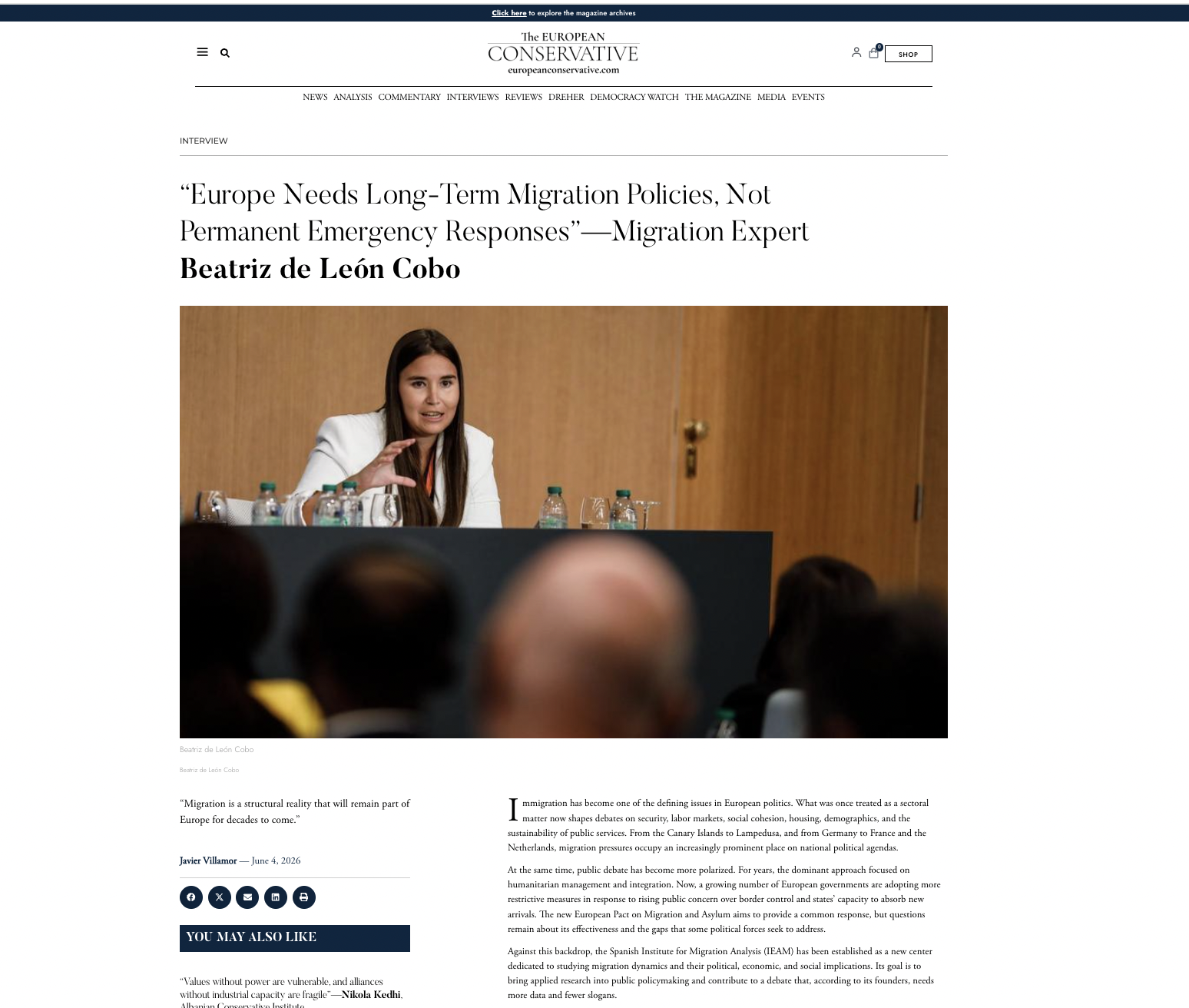
The European Conservative interviews Beatriz de León Cobo on migration, the Sahel, and European policy responses
IEAM's director discusses current migration challenges, the polarisation of public debate, and the need for more technical, precise, and long-term migration policies.
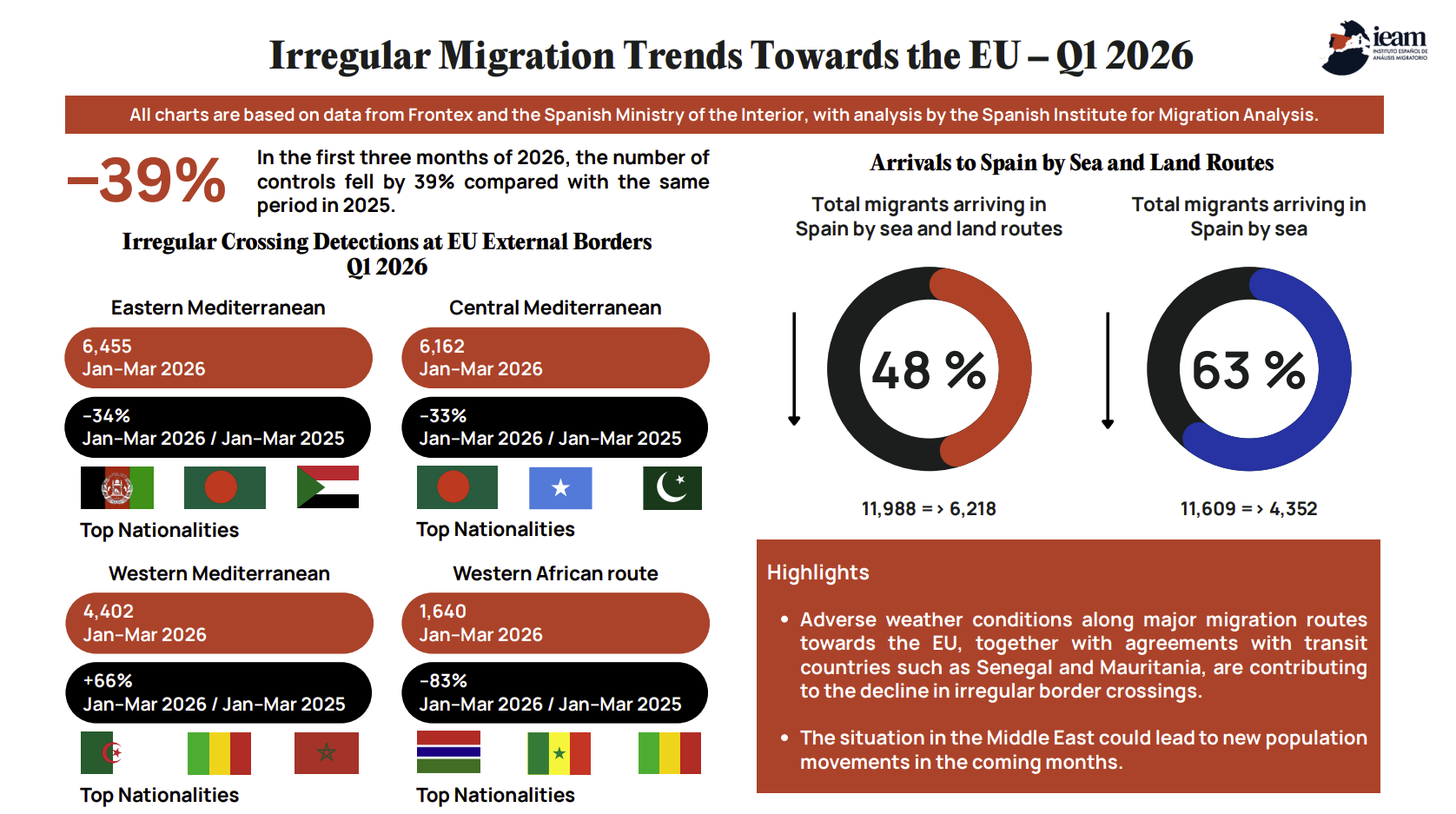
Irregular Migration Trends Towards the EU – Q1 2026
Analysis of the main trends in irregular migration towards the EU in the first quarter of 2026, based on data from Frontex and the Spanish Ministry of the Interior.
Credible legal pathways: Between political promise and actual capacity
Strategic guidelines to turn legal pathways into effective and sustainable mechanisms.
Get in touch with us
Do you have any questions or comments? We are here to help and collaborate on migration and public policy projects.