Irregular Migration Trends Towards the EU – Q1 2026
Analysis of the main trends in irregular migration towards the EU in the first quarter of 2026, based on data from Frontex and the Spanish Ministry of the Interior.
This analysis by the Spanish Institute for Migration Analysis (IEAM) examines the main trends in irregular migration towards the European Union in the first quarter of 2026, based on data published by Frontex and the Spanish Ministry of the Interior. It highlights the continued evolution of irregular border crossings, as well as changes observed in arrivals to Spain.
Decline in irregular crossings at EU external borders
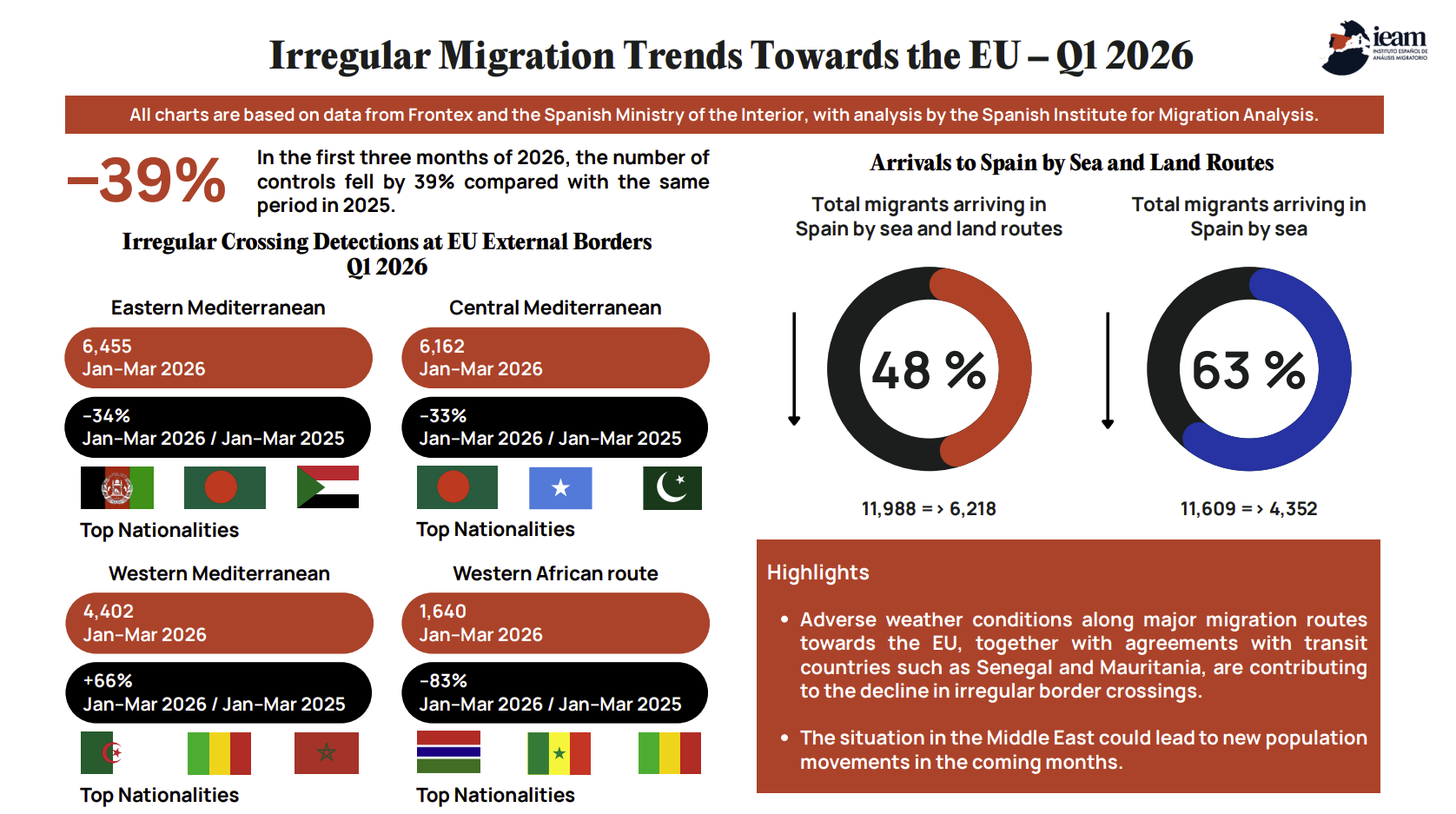
In the first three months of 2026, irregular border-crossing detections fell by 39% compared with the same period in 2025, with just over 21,400 crossings detected, according to preliminary data from Frontex.
Diverging trends across migration routes
In the first quarter of 2026, the Eastern Mediterranean remained the main migratory route into the European Union, with 6,455 detections, a 34% decrease compared with the first quarter of 2025. Afghan, Bangladeshi, and Sudanese nationals were among the main nationalities using this route.
The Central Mediterranean followed closely, with 6,162 detections, representing a 33% year-on-year decline. Bangladeshi, Somali, and Pakistani nationals were among the main nationalities using this route.
The Western Mediterranean was the only major route to record an increase, with 4,402 detections, a 66% rise compared with the first quarter of 2025. Algerian, Malian, and Moroccan nationals were among the main nationalities using this route.
In contrast, the West African route recorded the steepest decline among the main routes, with 1,640 detections, an 83% decrease year-on-year. Gambian, Senegalese, and Malian nationals were among the main nationalities using this route.
Arrivals to Spain by Sea and Land Routes
Spain recorded a total of 6,218 arrivals by sea and land routes in the first quarter of 2026, compared with 11,988 during the same period in 2025, a decrease of 48.1%. However, the sharpest decline was observed along sea routes, where arrivals fell by 62.5%, from 11,609 in the first quarter of 2025 to 4,352 in the first quarter of 2026. This decrease was mainly driven by a strong contraction in arrivals to the Canary Islands, which dropped by 82.6%, from 9,424 to 1,640. This trend reflects the significant decline observed along the West African route at EU level.
Highlights
Adverse weather conditions along major migration routes towards the European Union, as well as agreements with countries including Senegal and Mauritania, are among the main factors behind the overall decline in irregular arrivals.
The evolving situation in the Middle East could lead to further population movements in the region in the coming months.
IEAM Team
Research
Keep exploring
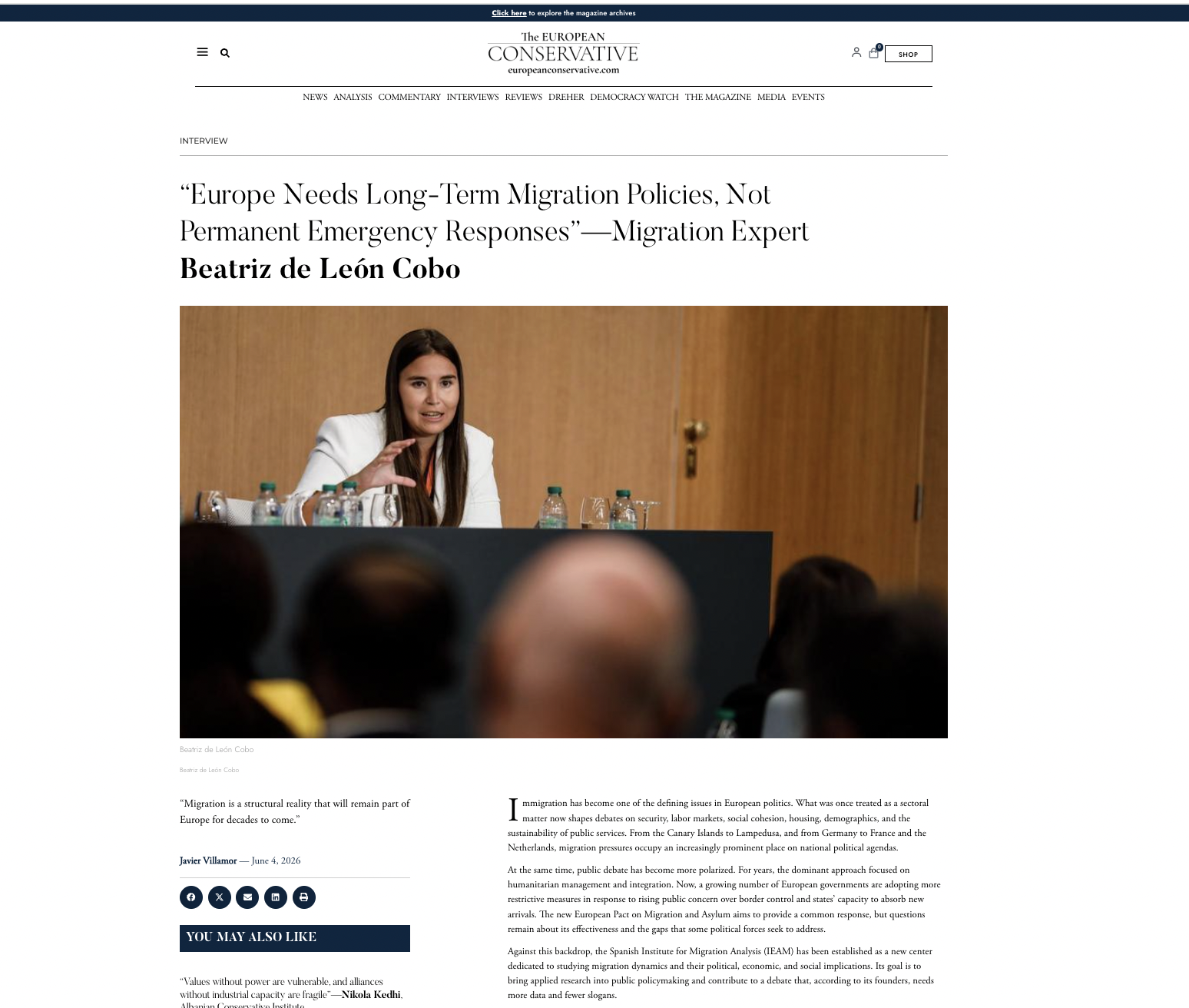
The European Conservative interviews Beatriz de León Cobo on migration, the Sahel, and European policy responses
IEAM's director discusses current migration challenges, the polarisation of public debate, and the need for more technical, precise, and long-term migration policies.

Credible legal pathways: Between political promise and actual capacity
Strategic guidelines to turn legal pathways into effective and sustainable mechanisms.

Route-based approach: Reducing visible flows or reducing vulnerabilities?
Towards a coherent strategy for protection and the fight against criminal economies.
Get in touch with us
Do you have any questions or comments? We are here to help and collaborate on migration and public policy projects.