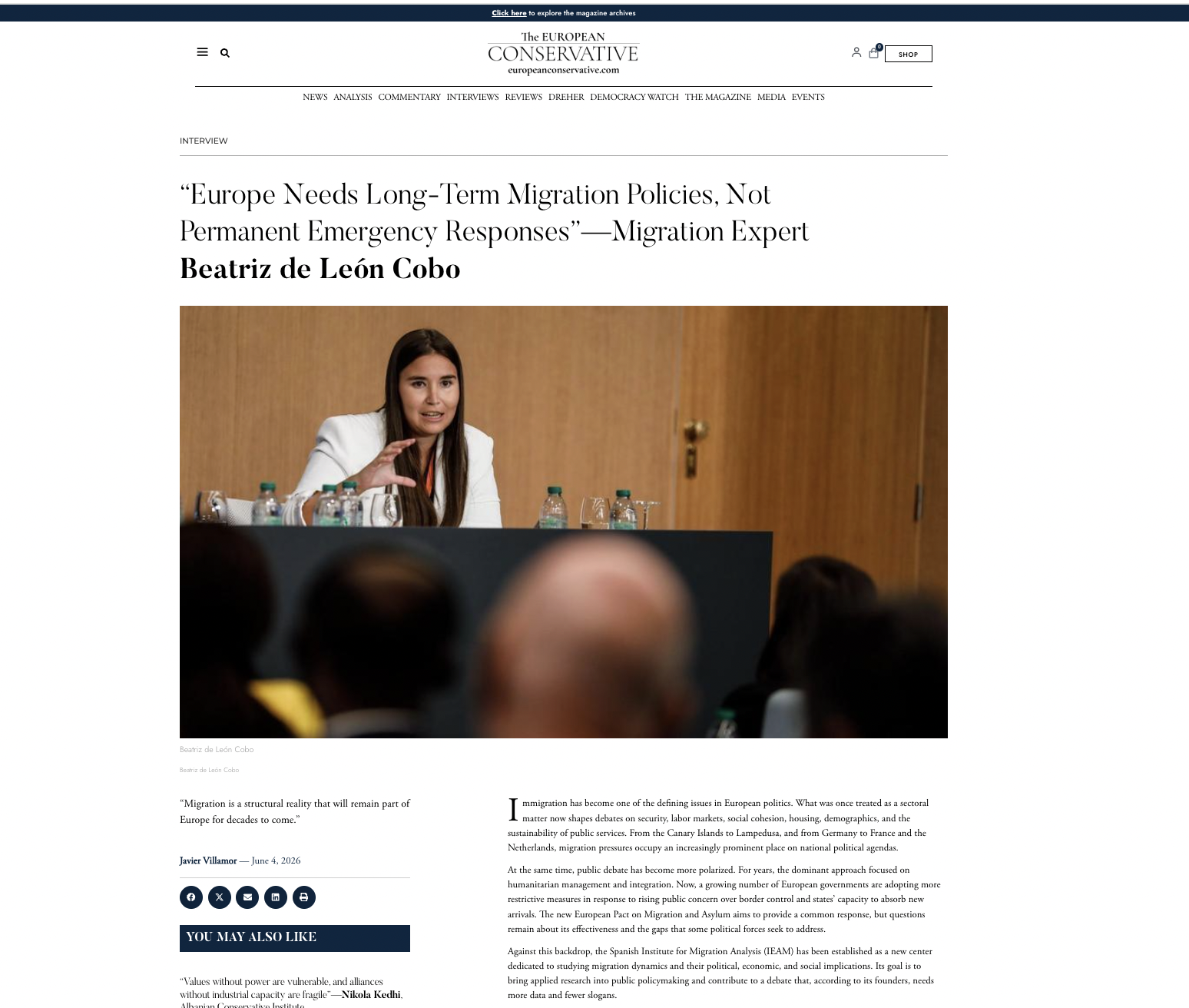
The European Conservative interviews Beatriz de León Cobo on migration, the Sahel, and European policy responses
IEAM's director discusses current migration challenges, the polarisation of public debate, and the need for more technical, precise, and long-term migration policies.
The European Conservative interviews Beatriz de León Cobo on migration, the Sahel, and European policy responses
The European Conservative has published an interview with Beatriz de León Cobo, Director of the Spanish Institute for Migration Analysis — IEAM —, on Europe's current migration challenges, the relationship between human mobility and regional stability, and the need to move beyond responses based solely on emergency management.
The interview, conducted by journalist Javier Villamor, addresses the creation of IEAM, the polarisation of migration debates in Europe, irregular arrivals, the situation in the Sahel, the European Pact on Migration and Asylum, cooperation with countries of origin and transit, and the limits of simplified solutions to complex public policy challenges.
Read the full interview in The European Conservative
A migration debate marked by polarisation
In the interview, Beatriz de León Cobo explains that IEAM was created with a clear mission: to contribute to a more rigorous, technical, and policy-oriented migration debate. Migration has become one of the most polarised issues in European politics, often shaped by emotion, simplification, and short-term responses.
From this perspective, the Institute seeks to introduce nuance and distinguish between migration realities that are often grouped under a single term, but which respond to very different logics: legal migration, international protection, irregular arrivals, unaccompanied minors, second-generation communities, social integration, and labour mobility.
IEAM's objective is to produce applied research, generate concrete recommendations, and build bridges between academic knowledge, field-based experience, and the needs of public institutions.
Managing migration beyond permanent emergency responses
One of the central messages of the interview is that migration remains manageable, but only if it is approached with a realistic and long-term perspective. A temporary decrease in arrivals can be relevant, but it should not be confused with a structural solution.
Beatriz de León Cobo underlines that migration dynamics are linked to economic, demographic, educational, political, and security factors. Strengthening a border or deploying additional resources may work for a period of time, but it does not, by itself, transform the underlying drivers of mobility.
The interview therefore stresses the need to move away from a logic of permanent emergency management and towards more precise, sustained, and context-specific policies.
The Sahel, West Africa, and routes towards Europe
A significant part of the interview focuses on the Sahel, a region on which Beatriz de León Cobo has worked for several years and which occupies a central place in IEAM's research agenda.
As she explains, one of the main challenges in Europe is the tendency to oversimplify what is happening in the region. The Sahel cannot be understood solely through the lens of terrorism or insecurity. The reality is much more complex: the presence of groups linked to Al-Qaeda and the Islamic State, institutional fragility, internal displacement, economic decline, governance problems, local conflicts, and pressure on livelihoods.
The interview also recalls that not every episode of violence automatically translates into migration towards Europe. Most displacement first takes place within the country of origin or towards neighbouring states. However, when insecurity persists over time, it weakens agriculture, trade, employment, and trust in the future, indirectly increasing migration pressure.
Security, illicit networks, and protection
The conversation also addresses the relationship between migration and security. Beatriz de León Cobo warns against exaggerations and against automatically identifying migrants as a threat. At the same time, she recognises that there is a security dimension that should not be ignored.
In environments such as the Sahel, networks involved in human smuggling, arms trafficking, and other illicit markets may coexist in areas where armed groups are also present. This requires technical analysis, cooperation with countries of origin and transit, and responses that clearly differentiate between people in situations of vulnerability and the criminal structures that profit from their mobility.
This approach is closely aligned with one of IEAM's main lines of work: reducing migrants' vulnerabilities while addressing the criminal economies that consolidate around certain routes.
The European Pact on Migration and Asylum
The interview also analyses the European Pact on Migration and Asylum, presented as a broad reform of European migration policy. Beatriz de León Cobo notes that the real challenge will lie in implementation.
The Pact is not a single measure, but a set of rules and mechanisms related to asylum procedures, border management, cooperation with third countries, returns, and visas. Its impact will therefore need to be assessed in specific territories, such as the Canary Islands, and in Europe's relationship with African countries of origin and transit.
For IEAM, one of the key questions will be whether the Pact addresses structural problems or merely improves certain aspects of administrative management.
Long-term migration policies
The interview concludes with a clear recommendation to Brussels: stop looking for simple solutions to complex problems.
Migration is part of Europe's structural reality and will remain so for decades to come. Public policies must therefore become more technical, more precise, and more focused on the long term.
This means working with countries of origin and transit, better understanding different migration dynamics, distinguishing between profiles and needs, opening credible legal pathways, strengthening cooperation, and designing responses adapted to each context.
As Beatriz de León Cobo argues in the interview, slogans may help win political debates, but they rarely solve complex problems.
About the interview
The interview was published by The European Conservative on 4 June 2026 and was conducted by Javier Villamor, a journalist and analyst specialising in European affairs, security, and international politics.

IEAM Team
Communications
Keep exploring
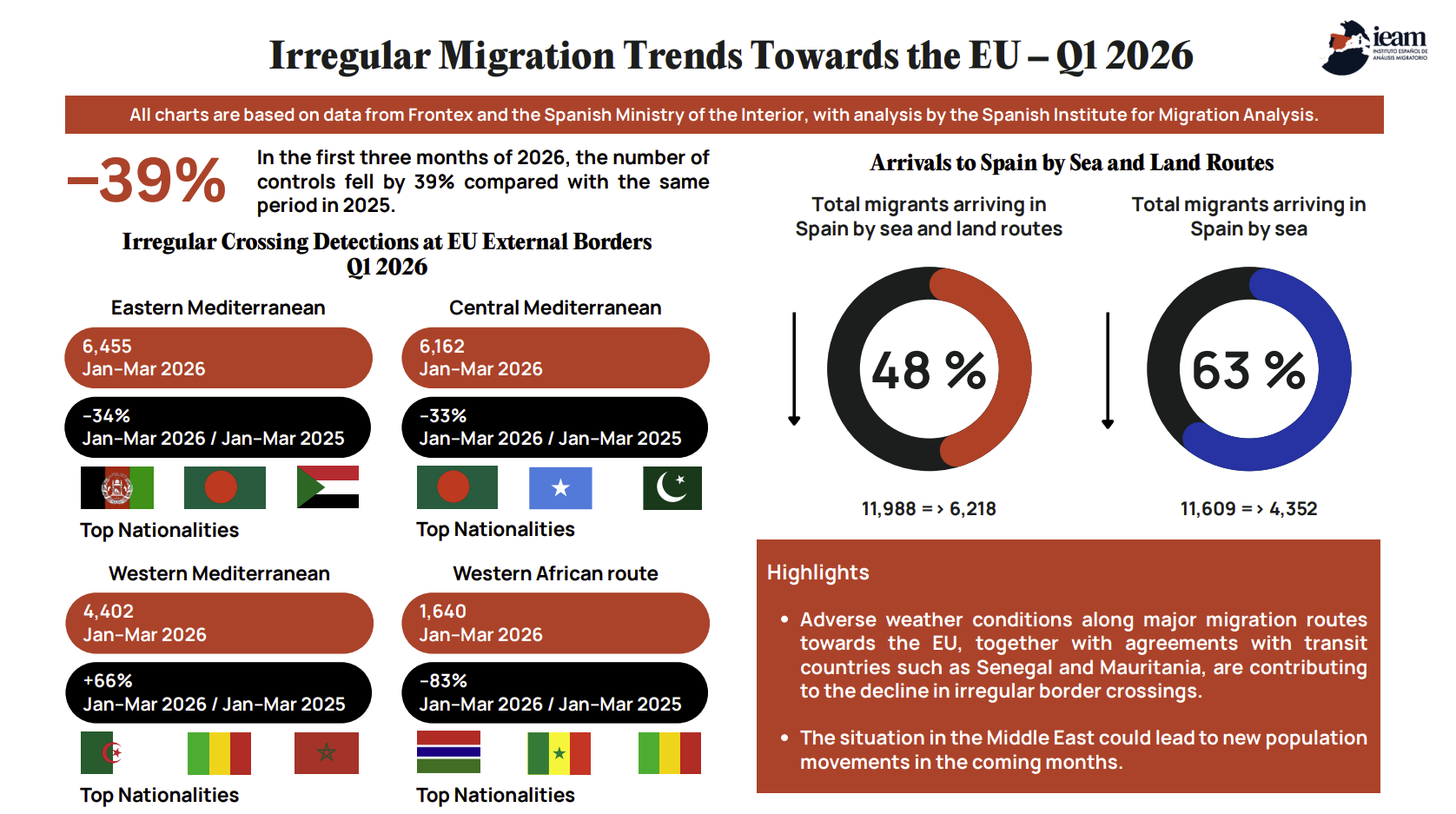
Irregular Migration Trends Towards the EU – Q1 2026
Analysis of the main trends in irregular migration towards the EU in the first quarter of 2026, based on data from Frontex and the Spanish Ministry of the Interior.
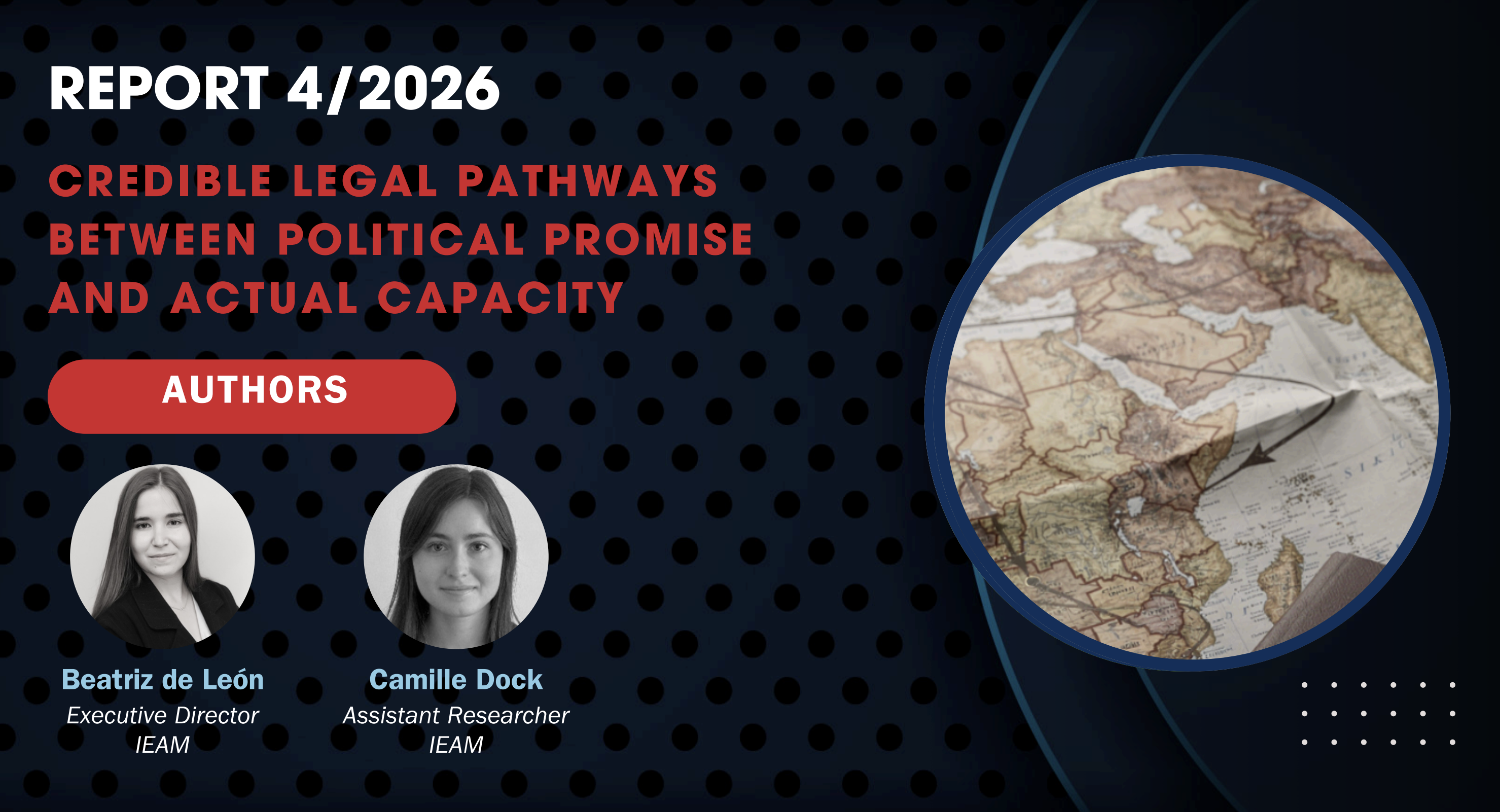
Credible legal pathways: Between political promise and actual capacity
Strategic guidelines to turn legal pathways into effective and sustainable mechanisms.
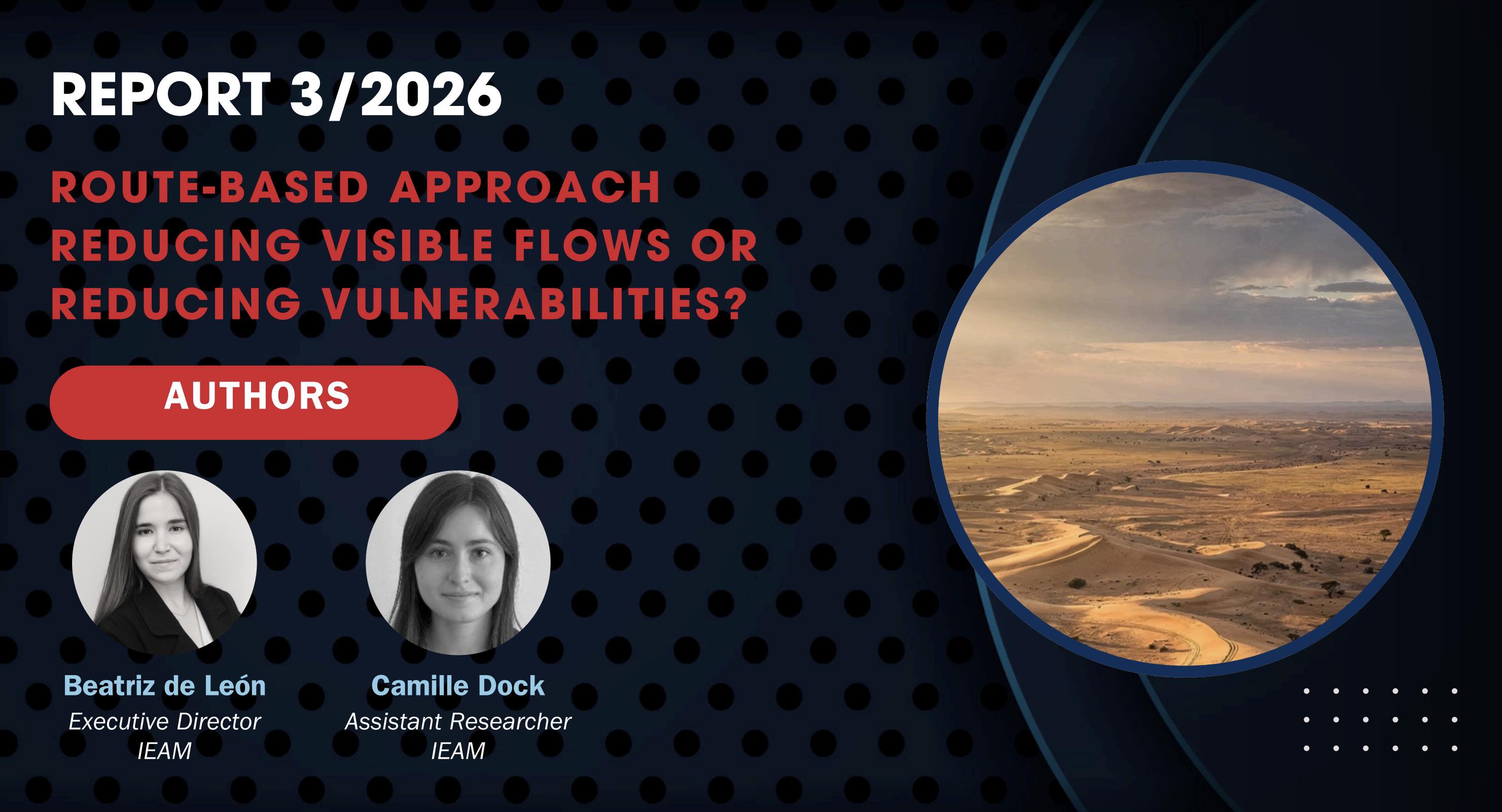
Route-based approach: Reducing visible flows or reducing vulnerabilities?
Towards a coherent strategy for protection and the fight against criminal economies.
Get in touch with us
Do you have any questions or comments? We are here to help and collaborate on migration and public policy projects.