Migration and Migrants: How to Study Irregularity in Migration Processes?. Spain: A Case Study (Part I)
A comprehensive analysis of the evolution, dynamics, and challenges of irregular migration to Spain within the European context (2015-2025).
Irregular migration to Europe has undergone profound transformations in recent decades. Spain, in particular, has consolidated its position as one of the main receiving countries for irregular arrivals within the European area, in a context marked by instability in West Africa, sustained pressure along the Atlantic and Mediterranean routes, and the growing externalization of borders by the European Union. In 2025, these two routes connecting to the Canary Islands and the Iberian Peninsula accounted for 22% of the total irregular arrivals to the EU. Understanding these dynamics is essential to interpreting recent trends and their implications.
The purpose of this report is to analyze the evolution of irregular migration to Spain over the last decade, situating it within the European context and examining its main manifestations using official and humanitarian sources. The study provides an integrated view of migration trends and flows, routes used, and challenges related to reception and protection systems, highlighting their complexity, structural nature, and evolution over time. The report is structured around three axes: i) irregular migration in the European context, based on Frontex data; ii) irregular migration in Spain, drawing on information from the INE, the Permanent Observatory on Immigration, the IOM, and Caminando Fronteras; and iii) international protection processes, with data from the Ministry of Interior and CEAR.
Key Findings
1. Irregular migration to Europe shows a structural and sustained dynamic
Irregular migration to Europe constitutes a persistent and structural phenomenon, with variations in intensity and location associated with political conjunctures, armed conflicts, and changes in border control mechanisms. Between 2015 and 2025, more than four million people crossed the external borders of the European Union irregularly.
The years 2015 and 2016 concentrated more than half of these entries, in relation to the war in Syria, while the 2021–2025 period shows a new cycle of increase following the decrease recorded during the COVID-19 pandemic. In 2025 (until August), the routes with the greatest weight were the Central Mediterranean (37%) and the Eastern Mediterranean (28%), while the routes entering through Spain (the Atlantic and Western Mediterranean) jointly represented around 22% of total irregular arrivals to the EU. Historical evolution shows that reinforcing control on certain routes does not eliminate flows but tends to cause their geographical reorientation.
Frontex data also show high diversity in countries of origin. In 2025, the main nationalities of people arriving irregularly in Europe were Bangladesh (13,927 people), Egypt (11,026), Afghanistan (8,935), Mali (6,129), Sudan (5,959), and Eritrea (5,957), among others, with differentiated entry patterns according to geographical proximity and routes used.
2. Irregular migration to Spain shows heterogeneous territorial and temporal patterns
Quantitatively, irregular arrivals by sea and land represent only a minor portion of total international migration to Spain, and even of the total population in irregular administrative status. A significant share of the irregular population has entered Spain through regular channels and later become irregular due to visa or residence permit expiration.
Nevertheless, irregular arrivals by sea and through the land borders of Ceuta and Melilla attract considerable media and political attention. Data from the Ministry of Interior shows significant fluctuations since the early 21st century, with a first major peak in 2006, when nearly 40,000 people arrived irregularly, 81% of them via the Canary Islands. Currently, arrivals by boat to the Canaries mainly come from Morocco, Mauritania, Senegal, and Gambia.
After a decade of relatively contained numbers, from 2016 onward there was a progressive and sustained increase in maritime arrivals, reaching historic peaks in 2019, and again in 2023 and 2024, surpassing the levels recorded in 2006. The year 2024 marked the highest value in the entire historical series analyzed. Provisional data for 2025, up to mid-September, show numbers lower than in 2024 for the same period but higher than in 2023, creating uncertainty about the final evolution for the year.
Territorially, the report identifies a structural change in the geographic distribution of arrivals. While in the early years of the period analyzed the Iberian Peninsula and Balearic Islands concentrated most maritime arrivals, from 2020 a clear inflection point positioned the Canary Islands as the main entry point, surpassing 70% of total maritime arrivals to Spain since 2023. This concentration remained through 2024 and much of 2025, although in the summer months of 2025 there was a relative increase in arrivals to the Peninsula and Balearic Islands and a slight slowdown in the Canaries.
Territorial differences are also reflected in entry routes and arrival profiles. In Ceuta and Melilla, land entries predominate, with peak periods between 2017 and 2019, when annual arrivals exceeded 6,000. Currently, Ceuta records a higher number of arrivals than Melilla.
3. Centrality of the Atlantic route and pressure on the Canary Islands
Migration pressure on the Canaries has remained high since 2020 and intensified from 2023 onward. The report shows that the archipelago has become the main entry point for irregular migrants to Spain, driven by structural dynamics such as departures from the West African Atlantic coast, variations in controls in Morocco and Mauritania, and the perception of this route as an alternative to the Western Mediterranean. In 2024, the Canaries recorded over 60,000 arrivals, representing more than 70% of total arrivals to Spain.
This increase confirms the persistence of one of the most dangerous routes in the world, with high levels of deaths and disappearances. Moreover, the islands bear a disproportionate share of the initial arrival pressure, causing saturation in reception facilities and complicating transfer to the mainland.
4. A transforming management and regularization system
Spain became a receiving country before having a fully developed migration policy, resulting in successive extraordinary regularization processes for residents already in the country. These processes created a migration regime combining regular channels with later regularization mechanisms, especially through arraigo (roots procedure).
In 2025, over 328,000 people resided in Spain under various arraigo schemes (social, labor, family, or educational), mainly from Colombia (25%), Morocco (17%), and Peru (8%). The introduction of educational arraigo in 2022 opened new labor insertion pathways in sectors with labor shortages, although its reach remains limited relative to the total irregular population.
5. International cooperation and externalization of border control
Institutional responses to irregular migration largely depend on international cooperation. The externalization of border control is a central pillar of Spanish and European migration policy, based on monitoring, control, and readmission agreements with countries of origin and transit. These mechanisms have contributed to a spatial and temporal reconfiguration of flows, without necessarily resulting in a sustained decline in arrivals. In 2023, for example, Morocco received over €500 million in European funding for this area.
6. Structural measurement challenges and humanitarian dimension
The report highlights structural difficulties in accurately quantifying irregular migration, particularly regarding deaths and disappearances along routes to Spain. It also emphasizes the close link between irregular migration and international protection, as a significant portion of arrivals come from conflict-affected or highly unstable countries and may meet the criteria to request asylum.
Since 2015, there has been a significant increase in international protection applications in Spain, rising from 3,422 in 2011 to 167,366 in 2024. Of all applications, 69% are accepted for processing, and of these, over 60% end with an unfavorable decision. In 2024 and 2025, the main nationalities applying for protection in Spain were Venezuela, Colombia, and Peru, along with Mali and Senegal.
Parallel analysis of data from the IOM’s Missing Migrants Programme and specialized organizations such as Caminando Fronteras shows that the Atlantic route accounts for a particularly high number of fatalities, in a context of longer crossings, adverse maritime conditions, and precarious vessels. However, the report notes that available figures likely underestimate the true magnitude of the phenomenon due to registration limitations.
Overall, the report highlights the complexity and persistence of irregular migration to Spain and its close connection to European and global migration dynamics. Findings show a changing phenomenon in its territorial and temporal manifestations, but structural in continuity, marked by strong inequalities among origin, transit, and destination regions, and by high pressure on certain border territories. In this context, Spain appears as a central observation point, both for its geographic position and for its role in European border control, reception, and protection systems. The Spanish experience, analyzed in detail, allows the identification of patterns, tensions, and challenges that transcend the national level and underscore the need to understand irregular migration as a complex, interdependent, and internationally conditioned phenomenon.
IEAM Team
Research
Keep exploring
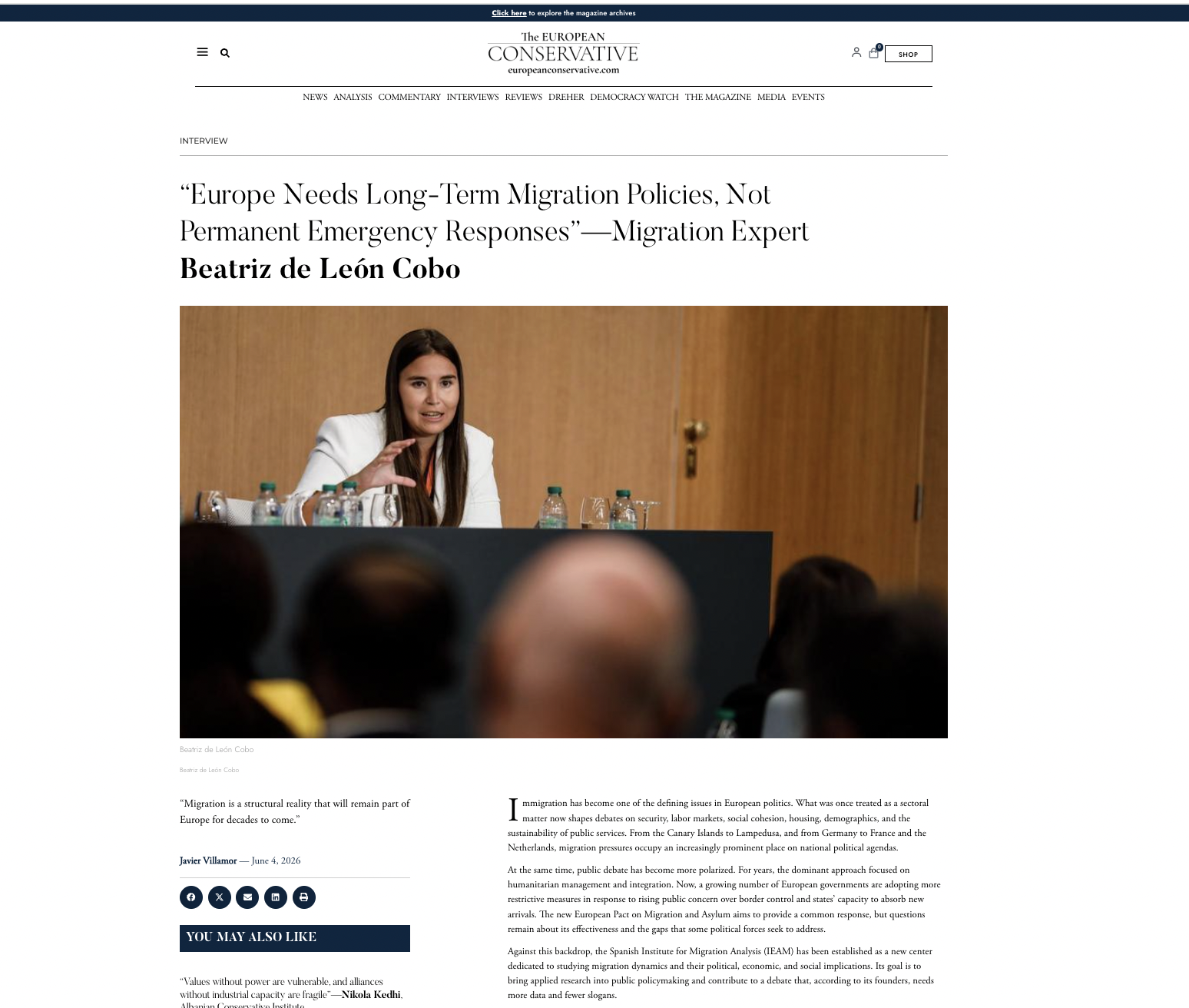
The European Conservative interviews Beatriz de León Cobo on migration, the Sahel, and European policy responses
IEAM's director discusses current migration challenges, the polarisation of public debate, and the need for more technical, precise, and long-term migration policies.
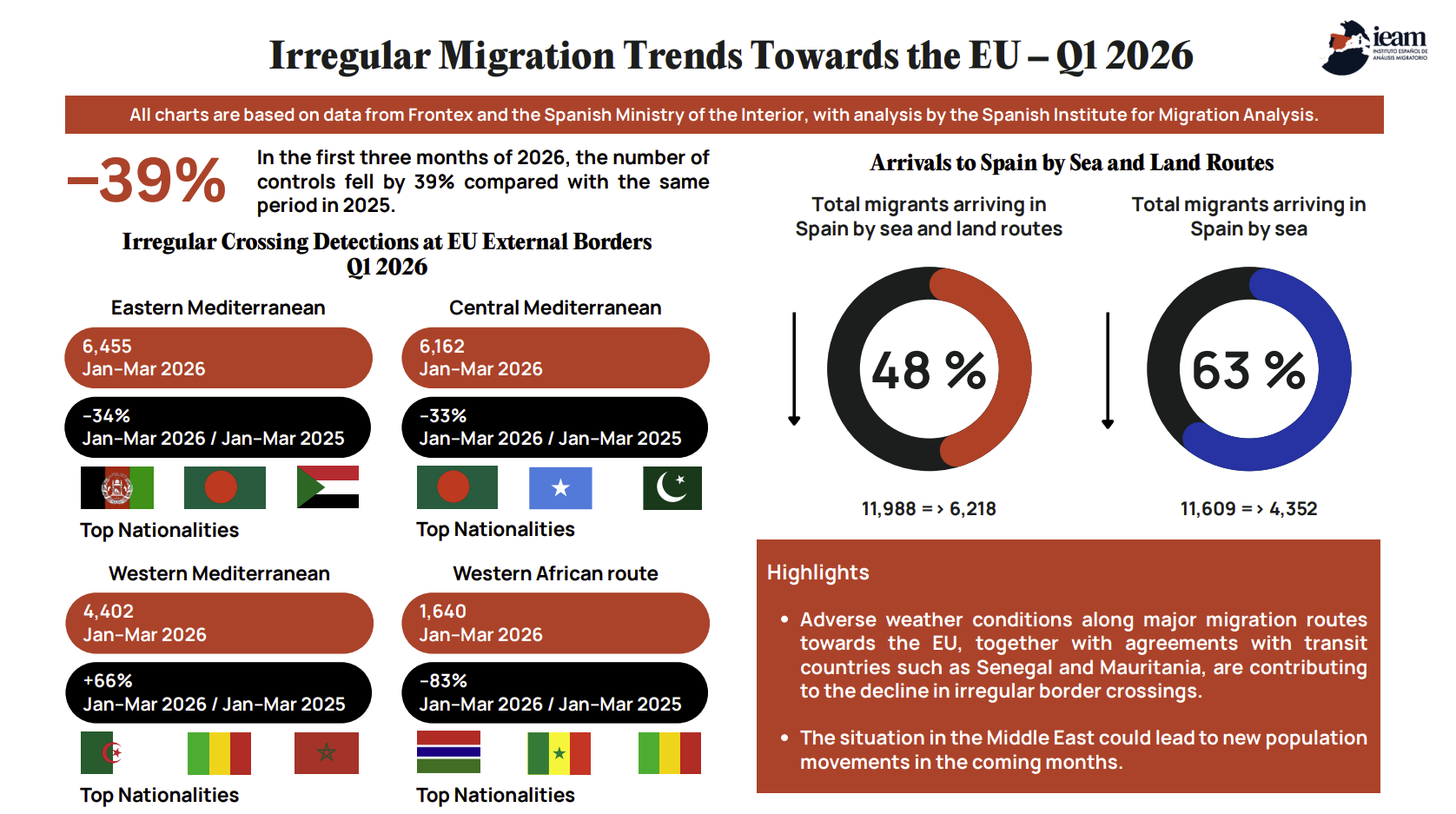
Irregular Migration Trends Towards the EU – Q1 2026
Analysis of the main trends in irregular migration towards the EU in the first quarter of 2026, based on data from Frontex and the Spanish Ministry of the Interior.

Credible legal pathways: Between political promise and actual capacity
Strategic guidelines to turn legal pathways into effective and sustainable mechanisms.
Get in touch with us
Do you have any questions or comments? We are here to help and collaborate on migration and public policy projects.